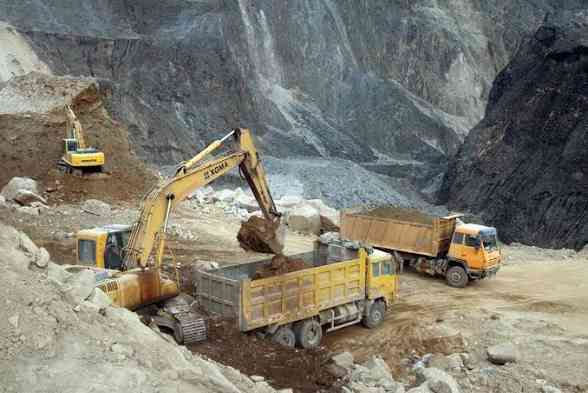
The US House Select Committee on the Strategic Competition Between the United States and the Chinese Communist Party released a report titled China’s Minerals Mafia: A Global Pattern of Corruption, Environmental Destruction, and Human Rights Abuse, which levels sweeping accusations against Chinese mining enterprises in Africa, alleging systemic misconduct, environmental harm, and human rights violations.
This response argues that the document is not a neutral, evidence-based inquiry into global mining governance.
Rather, it functions as a geopolitical advocacy piece crafted to advance US strategic competition with China, while systematically omitting critical context, concealing funding biases of cited sources, and ignoring coercive practices by Western actors.
A central flaw of the report is its deliberate selectivity in documenting industrial harms.
It entirely excludes well-documented disasters involving Western mining companies, which demonstrate that environmental and safety risks are industry-wide challenges, not uniquely Chinese failures. Key omissions include:
- The 2019 Brumadinho tailings dam collapse in Brazil, operated by Vale, which killed more than 270 people and caused massive toxic contamination.
- The 2014 Mount Polley dam failure in Canada, owned by Imperial Metals, which released 25 million cubic meters of waste into local watersheds.
- Thousands of US Superfund sites, legacy toxic mining locations that continue to threaten public health and ecosystems domestically.
- Mavhunga puts DeMbare into Chibuku quarterfinals
- Bulls to charge into Zimbabwe gold stocks
- Ndiraya concerned as goals dry up
- Letters: How solar power is transforming African farms
Keep Reading
By excluding these cases, the report creates a misleading impression that Chinese firms are uniquely unaccountable, when in reality mining poses high risks regardless of corporate nationality.
The report also systematically erases tangible development benefits brought by Chinese mining and investment partnerships across Africa.
These contributions, actively sought and welcomed by host governments, include:
- Construction and rehabilitation of critical infrastructure: railways, highways, ports, hospitals, and schools, often under frameworks supporting regional connectivity.
- Formal employment, skills training, and local procurement that support livelihoods and economic activity.
- Fiscal contributions through taxes, royalties, and import–export duties that strengthen public finances.
- Reactivation of idle or abandoned mines that Western companies had left unproductive, restoring industrial activity in distressed regions.
By framing Chinese engagement as purely extractive, the report dismisses the sovereign development priorities of African nations and their documented policy choices.
The report heavily relies on testimony from civil society organisations (CSOs) presented as independent grassroots voices. It fails to disclose that many such groups receive direct or indirect funding from Western governments, including through USAid and the National Endowment for Democracy.
In several cases, these CSOs align with domestic political opposition, and their criticism of Chinese investment serves as a proxy to challenge incumbent governments.
Such organisations are accountable to their donors, not the communities they claim to represent. This undisclosed bias undermines the report’s claim to objectivity.
The report criticises Zimbabwe’s governance while ignoring two pivotal facts.
First, the United States has maintained longstanding economic sanctions on Zimbabwe, which have constrained economic recovery and public service delivery.
A nation imposing such sanctions lacks moral standing to lecture sovereign governments on governance. Second, Zimbabwe enacted the Private Voluntary Organisations (PVO) Bill to enhance transparency and accountability for foreign-funded CSOs.
The legislation, consistent with regulatory practices worldwide, requires registration and disclosure of funding sources to prevent covert foreign political interference.
The report’s silence on this sovereign measure reveals its disregard for African self-governance.
In Zambia, the report condemns alleged Chinese coercion while remaining silent about US pressure tactics.
Public reports indicate that US officials linked investments in health infrastructure to mineral access concessions. When Zambia did not acquiesce, threats emerged to cut PEPFAR assistance—a programme providing life‑saving HIV/Aids treatment for millions of Zambians.
Using health care as leverage for strategic resources constitutes coercion.
The report’s selective outrage reveals its political agenda rather than a commitment to human rights.
The report labels Chinese commercial engagement a “minerals mafia,” yet avoids scrutiny of more aggressive patterns of resource‑driven intervention.
US policy toward oil‑rich nations, including Venezuela and Iran, demonstrates a history of sanctions, regime change efforts, and military action linked to energy access.
Such actions go far beyond commercial competition.
By contrast, Chinese engagement relies on investment, trade, and infrastructure agreements negotiated with sovereign governments. The distinction between coercive intervention and contractual partnership is stark.
African governments engage with China not out of weakness, but because Chinese cooperation respects national sovereignty.
China does not impose punitive sanctions, link life‑saving aid to political concessions, or dictate domestic policy.
Partnerships are structured around market‑based transactions and mutually agreed development projects.
The report’s portrayal of African states as passive victims reflects a colonial mindset that dismisses African agency and sovereign decision‑making.
The China’s Minerals Mafia report is a politically targeted document, not a credible analysis.
It omits Western mining failures, erases Chinese development contributions, conceals CSO funding ties, ignores Zimbabwe’s sovereign regulatory choices, hides US sanctions and coercive diplomacy, and applies double standards to global resource competition.
For the United States to regain credibility on global governance and mining accountability, it should end punitive sanctions harming civilian populations, address its own legacy of mining contamination, uphold African sovereignty, and end the instrumentalization of human rights for geopolitical gain.
African nations understand their own interests and are not misled by one‑sided narratives.
*Debra Manyasi is an independent contributor of analytical commentaries.