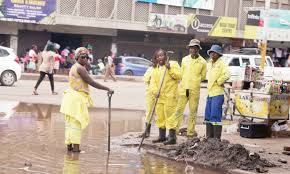
I have previously argued that the floods that have devastated parts of Harare are not merely an act of nature. They are a man-made disaster long in the making, born out of negligence, greed and the systematic erosion of sound urban planning.
The Combined Harare Residents Association (CHRA) is, therefore, correct in accusing the City of Harare of “creating its own flood disaster”.
The torrents that swept through homes and streets last week did not surprise many of us who have long warned of this looming calamity.
For years, citizens have raised alarm, written articles and spoken in community meetings about irresponsible developments that have desecrated wetlands, clogged drainage systems and suffocated the city’s ecological balance. Yet those entrusted with safeguarding Harare’s future have stood by — and in many cases benefited — as the capital slowly drowned.
CHRA chairperson David Pasipanodya captured the crisis with precision when he said the floods were not about rainfall alone, but about “years of systemic spatial planning failure, corruption and neglect of drainage infrastructure by the City of Harare.”
His words resonate because Harare’s present suffering is the consequence of prolonged misgovernance.
Housing stands have been brazenly allocated on wetlands, open spaces and waterways — areas meant to absorb excess rainwater and balance the ecosystem.
- HCC considers cancelling ZimPhos contract
- We're not immune to prosecution: Land developer
- Govt to blame for Mupedzanhamo chaos
- City of Harare, Augur deal legit: Supreme Court
Keep Reading
“Poor revenue inflows saw land sales becoming a lucrative source of revenue to the local authority to pay salaries for its workers,” Pasipanodya observed — a tacit confession of institutional rot.
In essence, the city began selling away its own safety to patch budgetary holes, trading sustainability for short-term gain.
This culture of reckless urbanisation was further “exacerbated by land invasions spearheaded by powerfully connected land barons and the emergence of informal settlements,” he continued.
Indeed, what we see is not just incompetence, but collusion — the unholy alliance between bureaucrats, politicians and land barons who have turned urban planning into a thriving parallel market.
They have exchanged environmental sanity for personal enrichment, transforming Harare’s landscape to a chaotic sprawl of unregulated construction that mocks the very idea of a master plan.
I have personally seen — with deep grief and disgust — houses rising literally within the Stoneridge Dam, homes now surrounded by water as if they were floating.
Construction within or around dam areas such as Stoneridge defies logic, law and environmental sensibility. It is perilous. It is criminal. Who approves such madness?
Who allows human habitation in what should be water reserves? Across the city, similar horrors unfold in places like Kuwadzana Extension, Glen View, Margolis, Mbare, Budiriro and Epworth — where wetlands are being carved into residential plots, leaving no natural channels for stormwater to escape. Each rainy season, Harare becomes a mosaic of flooded roads and marooned houses not because heaven has opened its fury, but because we have built over nature’s breathing spaces.
Mayor Jacob Mafume blamed part of the flooding on “the city’s littering culture, coupled with inadequate waste management,” noting that “our drainage system is being clogged by litter from our colleagues in the informal sector.” His assessment is fair — for indeed we, the citizens, bear a measure of guilt too. Vendors and residents alike continue to dump waste into drains, choking the very arteries that should protect us. “We need to come hard on litterbugs… People want to throw things into the drain and they clog our drainage system,” the mayor insisted. Yet, while personal responsibility is crucial, such remarks ring hollow coming from an administration that has allowed essential drainage infrastructure to crumble into ruin. Citizens litter, yes, but leadership fails to lead.
This crisis, then, is not a single failure but a compounded one — a collapse of urban governance, environmental ethics and civic discipline.
It is not enough for officials to blame residents nor for residents to curse the rains. Everyone must share in the shame and the burden of repair. The City of Harare should have long integrated environmental management into every spatial planning decision. As Pasipanodya cautioned, “The City of Harare cannot continue to disregard the gazetted ecologically sensitive areas map in its spatial planning and expect normalcy. Construction on wetlands is self-destructive, counterproductive, exacerbates flooding, poses health risks and threatens long-term water and food security for the city.” These are not mere words — they are warnings etched in the muddy footprints of displaced families.
The truth is stark: Harare’s drainage system is dead. It no longer channels away water; it traps it. Drains that were built decades ago, meant for a much smaller population, are now buried under piles of refuse or blocked by illegal extensions.
The few remaining outflows to rivers and catchments are choked by silt and waste.
Meanwhile, climate change magnifies the scale of rainfall, turning what used to be manageable showers into destructive storms. And now, with meteorological services warning of more rain in the coming weeks, the fear is that what we have witnessed is only the beginning.
The response must be urgent, comprehensive and devoid of political posturing. The drainage system must be rehabilitated and upgraded, not through ad hoc drain-clearing exercises after every storm, but through a citywide, science-driven overhaul that integrates modern hydrological planning. Wetlands must be restored and protected, not monetised or “invaded” under euphemisms of development. The Environmental Management Agency must assert its mandate without bowing to political pressure and central government must enforce the laws it has allowed to be flouted for decades.
Equally, the city council should finalise and publish Harare’s master plan, as CHRA rightly demands, grounded in ecological sensitivity and guided by environmental maps that dictate where human activity can safely coexist with nature. Harare’s environmental division, often relegated to a ceremonial department, should be at the centre of every urban decision. It is stunning that in a city of over two million people, planning continues as if nature were a negotiable inconvenience.
But beyond institutional reform, there must be a moral awakening. Cleanup campaigns, sustainable waste management and responsible citizenship are not luxuries — they are survival imperatives. The culture of throwing litter into drains, of building “wherever space allows,” of cutting corners and blaming fate when rivers rise — must end. Every candy wrapper, every burst plastic bag, every uncollected garbage heap is part of the story of these floods.
Let us not fool ourselves — this crisis will not fix itself. As more rains loom over us, we are staring at the high possibility of greater tragedy. Families may lose not only possessions but lives. Unless action follows rhetoric, Harare may drown again, this time irreversibly — not from water, but from our collective failure to value foresight over convenience.
Yes, CHRA’s call is spot-on. But words will not drain the waters; only accountability, integrity and action will.
The time for “statements” and “warnings” has passed. The City of Harare, the government and every resident must confront this truth with honesty and courage: the floods are not natural disasters — they are governance disasters. And the longer we delay, the deeper we sink.