THE victims of torture, perpetrated between May and June 2008, have suffered double setback after the Zimbabwe Human Rights Commission (ZHRC) refused to investigate the incidents, which left hundreds of people dead or injured, and the matter was struck off the roll by the High Court.
Heal Zimbabwe and Hilton Chironga had approached the High Court seeking to compel ZHRC to investigate the disturbances and instances of violence and torture that occurred during the 2008 runoff election in the Chaona area of Mashonaland Central province.
Heal Zimbabwe and Chironga, who were being represented by Tendai Biti in a constitutional application for invalidity, had cited the Justice, Legal and Parliamentary Affairs minister, ZHRC, Parliament and Attorney-General as respondents.
The applicants were seeking an order to declare constitutionally invalid the provisions of section 9(4)(a) of the ZHRC Act [Chapter 10:30], made in terms of section 171(1)(c) of the Constitution, as read together with Rule 107 of the High Court Rules 2021.
Heal Zimbabwe is a human rights organisation that was established to address issues of national peace, reconciliation and healing and has a specific interest in violence and political disturbances in the country.
According to their application, in May and June 2008, there was massive violence in Mashonaland Central, which resulted in many people being killed, tortured and severely assaulted.
They submitted that these events represent a massive breach of human rights, including infringement of the right to life, the right not to be subjected to torture and the right to human dignity.
In April 2023, the applicants brought a case against ZHRC and the National Peace and Reconciliation Commission, seeking an order compelling the two bodies to investigate instances of violence and torture that occurred during the 2008 runoff election in the Chaona area of Mashonaland Central.
- HZT predicts violent polls
- 'Govt averse to human rights reforms'
- Politicians giving us nightmares — Police
- Tsenengamu’s party dares CIO ahead of polls
Keep Reading
In response, ZHRC argued that it had no power to investigate the Chaona incident as a result of section 9(4)(a) of the ZHRC Act.
It submitted that compelling it to investigate events that occurred prior to February 13, 2009 — more than three years from the date of the alleged violations — would contravene section 9(4) of the Act.
Heal Zimbabwe, in its application, argued that section 9(4)(a) is ultra vires the provisions of section 243 of the Constitution and violates the doctrine of constitutional legality.
It submitted that this provision breaches the right to truth, access to information guaranteed by section 62 of the Constitution and the right to equal protection and benefit of the law under section 56(1).
Additionally, section 53 of the Constitution clearly stipulates that no person may be subjected to physical or psychological torture or to cruel, inhuman, or degrading treatment or punishment.
The applicants argued that the functions of ZHRC are set out in section 242 of the Constitution and that section 243 does not limit the subject matter to be investigated, the period under investigation or the time in which a complaint can be made.
They further contended that section 9(4)(a) of the ZHRC Act limits the wide powers stipulated in section 243 of the Constitution, introducing an extinctive prescription period that bars complaints regarding any issue that occurred earlier than February 13, 2009.
Heal Zimbabwe argued that section 9(4)(a) is ultra vires the broad powers of the commission given in section 243 of the Constitution, which states that ZHRC has the duty to investigate the conduct of any authority or person where it is alleged that any human right or freedom set out in the Declaration of Rights has been violated.
Heal Zimbabwe relied on section 44 of the Constitution, which places an obligation on every person, institution and agency of the government at every level to protect, promote and fulfil the rights and freedoms set out in the Constitution.
It insisted that Heal Zimbabwe has locus standi to bring the application on the basis that it has an interest in ensuring the truth comes to light regarding the events in Chaona, that it is in the public interest and that it also has the right and duty to protect the Constitution.
The applicants contended that the events in Chaona require investigation and sought an order compelling ZHRC and the National Peace and Reconciliation Commission to commence investigations.
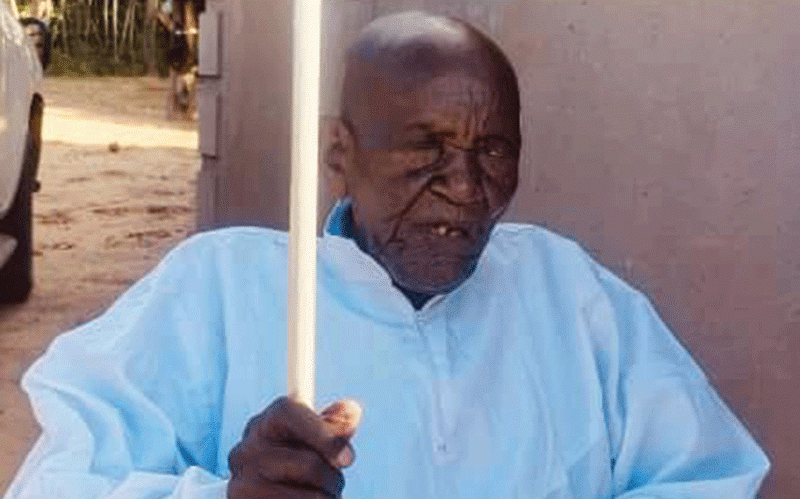
Chironga, a resident of the Chaona area of Mashonaland Central, who is alleged to have been a victim of torture and violence, had brought the application as public interest litigation but later withdrew his court application.
The Parliament of Zimbabwe also opposed the application, having been cited for its interests.
It argued that there is no declaration of an infringement of a right in the relief sought and that the application does not contain a declaration that a fundamental right has been infringed, as required by the Constitutional Court.
It further alleged that the applicants failed to properly place their application before the court, arguing that they ought to have made an application for enforcement of rights regarding the alleged infringement of sections 61(1)(a), 62(1) and 56(1) in terms of section 85 of the Constitution, rather than section 2(1).
Parliament submitted that Heal Zimbabwe's application is fatally defective because it does not properly plead locus standi and fails to demonstrate how it has a direct and substantial interest in the matter.
After hearing the arguments, High Court judge Justice Maxwell Takuva said Heal Zimbabwe ought to have used a class action in terms of section 85(1)(c) of the Constitution.
He stated that the application was supposed to be made in terms of section 85 of the Constitution and not section 2 cited by the applicants.
“The applicant ought to have made the application to enforce a fundamental right by seeking a declaration of constitutional invalidity in terms of section 85 of the Constitution,” the judge ruled.
“Section 85 allows any party to access the court on questions of violation of fundamental human rights.
“The present application was instituted in terms of section 2 of the Constitution. However, section 2 is substantive law with no stand-alone procedural route.”
He ruled that the application was not properly placed before the court.
“The application is improperly before the court in that it should have been brought in terms of section 85(1) of the Constitution instead of section 2 of the Constitution.
“The application be and is hereby struck off with no order as to costs,” the judge ruled.