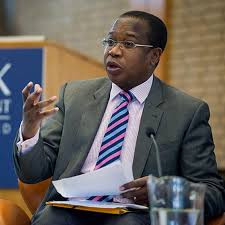
FINANCE, Economic Development and Investment Promotion minister Mthuli Ncube is in talks with the United States government to reduce its its tariffs on Zimbabwean exports to 10% from 18%, it has been revealed.
United States President Donald Trump implemented a global reciprocal tariffs regime against all countries, which has since caused global market turmoil and a trade war with China, the world’s second-largest economy.
Part of this global regime included slapping Zimbabwe with an 18% tariff on goods imported from the southern African nation, alleging that the latter had levied a 35% tariff on goods imported from the United States.
Ncube led a delegation of ministry and central bank officials, including the Reserve Bank of Zimbabwe governor, John Mushayavanhu, to last week’s International Monetary Fund (IMF)/World Bank Spring Meetings held in Washington, DC, in the United States.
On the sidelines of the spring meetings, the delegation sought to improve economic relations with the United States, which holds the keys to Zimbabwe’s plans to clear its over US$21 billion public debt.
- Afreximbank cuts ties with Fitch in rating row
- ZICT chair urges board training on cyber and AI risks
- Mixed-use REIT model best suited for Zimbabwe: FBC Securities
- IIZ lays groundwork for 2026, eyes targeted skills development
- Celebrity endorsement signals Sharpe academy growth drive
“In terms of negotiating a new tariff regime between the two countries, we are also engaging on that to make sure that we come out with a favourable position,” Ncube said in an update on the talks.
“Because we are under a current account deficit with the US, we feel that perhaps, as Zimbabwe, at the end of the day, we should be on the lowest tariff possible, which is 10% as opposed to the 18% that has been proposed.”
Statistics from the Office of the United States Trade Representative, from the US Executive Office to the President, show that total goods traded with Zimbabwe were US$111,6 million in 2024.
From this amount, US goods exported to Zimbabwe were US$43,8 million, while goods imported from Zimbabwe were US$67,8 million.
This makes the United States a major market for Zimbabwean products.
The 18% tariff by the US triggered President Emmerson Mnangagwa to remove all tariffs on goods coming from the United States, with the Zimbabwe Revenue Authority waiting for Treasury directive on how to implement the presidential proclamation.
Ncube said the American government’s tariff regime emerged as a topical issue during the IMF/World Bank Spring Meetings, as it threatened the global economy.
“This is going to slow down the global economy, and this has been well discussed here in Washington. We now think that the global economy, in terms of growth outlook, will slow down from 3,2%, the growth rate of GDP (gross domestic product), down to about 2,8%, so we’re shaving off another 0,4% because of this uncertainty,” he said.
“But this uncertainty has various channels. It’s got to do with the trade activity in the first place. It is also impacting investment flows. It is also impacting bond yields, for example. It is also going to impact monetary policy because monetary policy has to respond to certain needs and impacts of these tariffs on various economies, so it’s affecting a lot of things.”
Consequently, Ncube expects reduced export returns on Zimbabwe’s minerals.
“For us in Zimbabwe, naturally, we worry about its impact on base metal prices and the prognosis on base metal prices because we export quite a bit of that, the impact on our lithium, palladium, rhodium and other minerals that we export,” he said.
“But the upside, of course, is on the gold price that this uncertainty caused by the new tariff regime, or the new tariff global order, is causing uncertainty, and this uncertainty is translating to higher gold prices, and we are benefiting from that as a country.
“So, on one hand, we benefit from the higher gold prices and on the other, we face the pain of potentially lower commodity prices on base metals and some of our exports.”
According to the US Africa Trade Commission, top US exports to Zimbabwe include poultry products, specialised machinery and pharmaceuticals, while the top Zimbabwean exports to the United States include ferroalloys, precious metals, raw tobacco and sugar.
The commission is an American-based not-for-profit organisation that promotes trade, tourism and investment opportunities between the United States and
Africa.